
In this article, I’ll break down the meaning of Padmasana (Lotus Pose) in Sanskrit and explore the story and symbolism behind its name. You’ll also find key alignment cues to help you guide or practice this pose with more clarity and intention.
This post is part of a series created for yoga teachers and curious practitioners who find it challenging to memorize Sanskrit pose names. Personally, I’ve found that learning the history and meaning behind each posture makes the terminology easier to remember and deepens my connection to the practice. Let me know if it helps you as well.
What does Padmasana mean?
Padmasana is the name of one of the most ancient meditative poses of Hatha Yoga.
The name is derived from two Sanskrit roots:
Padma (lotus)
Asana (posture).
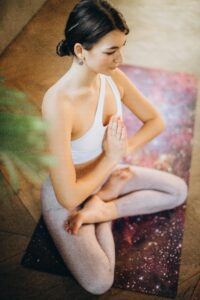

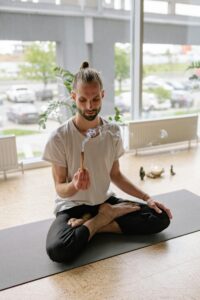
Symbolism of Padmasana
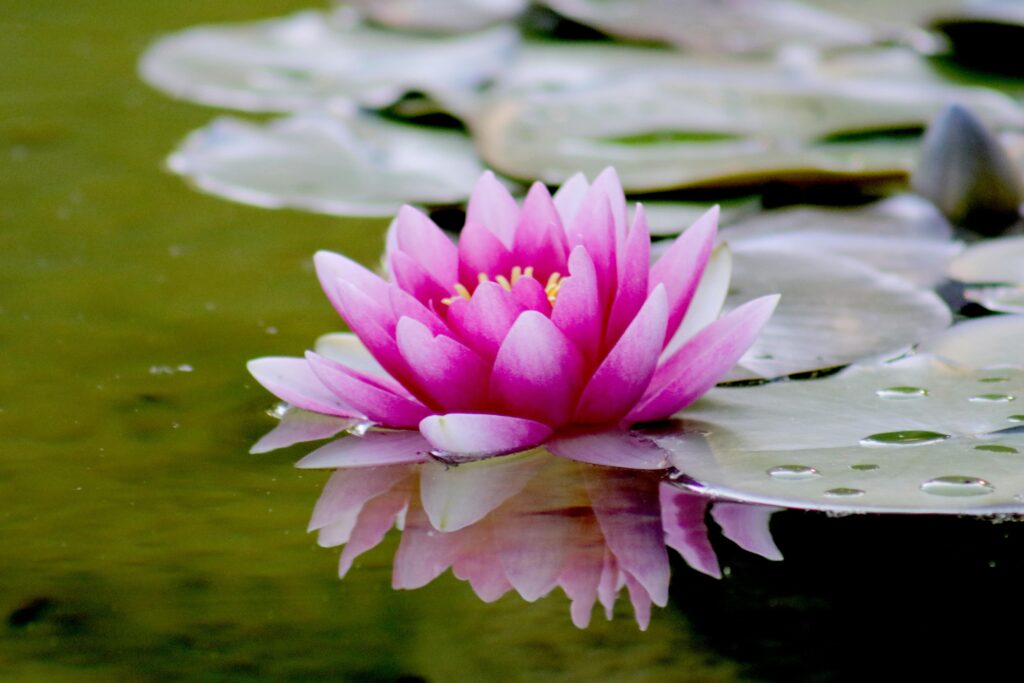
The lotus is a powerful and timeless symbol in the yogic tradition. Padmasana, or Lotus Pose, mirrors the graceful petals of this aquatic flower.
But beyond its physical form, the lotus serves as a profound metaphor for the yogic path.
Just as the lotus is rooted in the muddy riverbed yet rises above the surface to bloom untouched, the practitioner begins their journey grounded in the complexities of human life—entangled in the endless cycle of sorrow and joy: sickness and healing, births and farewells, rent payments, family obligations, and everyday responsibilities.
With continued practice and inner discipline, one gradually transcends these fluctuations. Like the lotus, we begin to unfold—petal by petal—growing toward light, clarity, and inner freedom. We rise, not by denying the mud, but by being nourished through it.
Symbolically, the sun that the lotus seeks represents knowledge or higher truth. Though submerged, the flower can’t see the sun directly—only its refracted light shimmering through the water. Yet that subtle glow is enough to guide its upward journey. In the same way, even a glimpse of truth can inspire us to grow and to stretch beyond illusion.
By sitting in this position, we become firmly rooted and as our practice deepens, the mind begins to ascend. We sit tall, like the lotus stretching upward through water toward the sun. Padmasana invites us into the higher limbs of yoga: concentration (dharana), meditation (dhyana), and ultimately, enlightenment (samadhi) (Kaivalya & Van der Kooij, 2010).
Alignment & Cues for Padmasana
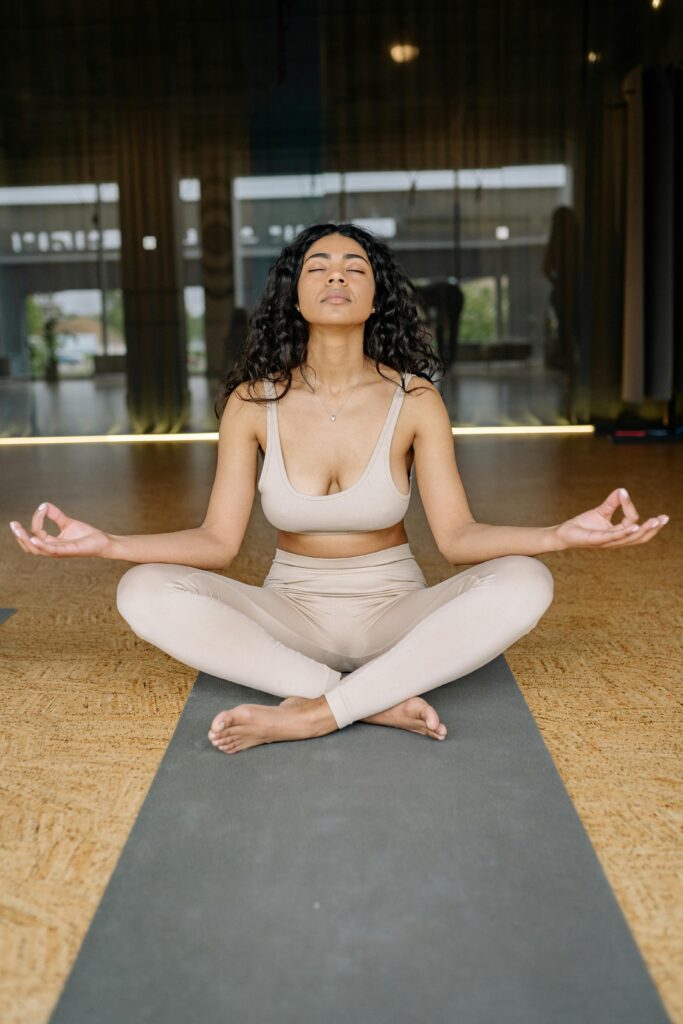
- Begin seated on your mat in a neutral cross-legged position. Sit on a folded blanket or block if your hips are tight, ensuring the pelvis is slightly tilted forward to support a natural lumbar curve.
- Anchor your sitting bones evenly into the mat and elongate your spine. Imagine a line of energy rising from your sacrum through the crown of your head, creating axial extension. Relax the shoulders down and slightly back, broadening the space in your collarbones.
- Extend your right leg out in front of you. Flex the foot to activate the muscles around the knee joint, protecting the ligaments as you externally rotate the hip. Guide the right foot toward your left hip crease, with the sole facing upward and the heel drawing in toward the lower abdomen.
- Now, bend the left knee and lift the foot, flexing at the ankle. Carefully place the left foot on the right thigh, ideally near the hip crease, keeping the sole facing up.
- Both femurs should externally rotate, and knees should descend toward the floor.
- Once stable, soften the shoulders, the neck and jaw, letting the arms rest naturally.
- Place the hands on the knees or thighs, optionally forming a mudra such as Chin or Jnana Mudra, with palms facing upward to encourage openness.
- Close the eyes gently. Inhale deeply into the diaphragm, expanding your side body, and exhale slowly through the nose, cultivating stillness and inner awareness.
- Slowly release your legs after a few breaths to the starting position when you complete your practice.
- To obtain and cultivate balance, repeat on the other side. Now bending the left leg first and then the right leg.
Modifications
There should be no pressure or pain in the knees.
If there is discomfort, ease out and try: Ardha Padmasana (Half Lotus Pose) or Sukhasana (Easy Pose) to maintain joint integrity.

Who should not practice Padmasana?
Contraindications
- Individuals with chronic knee injuries or pain.
- Those with ankle injuries or recurring ankle discomfort.
- Anyone experiencing lower back issues.
- People with sciatica or sacroiliac joint dysfunction.
- Individuals with knee arthritis or joint degeneration.
- If pregnant, avoid if experiencing swollen ankles or lower back pain.
Always consult a medical professional and an experienced yoga teacher before attempting Lotus Pose if you have any of the above conditions.
What’s the mythical history of Padmasana?
Before the beginning of time, Lord Vishnu lay in deep rest upon his cosmic couch: Ananta, the thousand-headed serpent. Together, they floated upon the vast ocean of potential—the cosmic sea where all universes return after each cycle of destruction.
As the moment for a new creation arose, a grand lotus began to sprout from Vishnu’s navel. The plant grew and its petals unfolded before him.
At the center of the blooming lotus sat Brahma, the four-faced deity of creation. Each face was facing a cardinal direction, and from each one of his four mouths, Brahma uttered one of the four parts of the sacred sound OM:
- Ah (as in father) represents creation or birth. It is presided over by Brahma, the Creator.
- Ooo (as in room) symbolizes the sustenance of life. It is associated with Vishnu, the Preserver.
- Mmm represents transformation, destruction, or death, and is linked to Shiva, the Destroyer.
Together, these syllables form the sacred sound AUM (or OM)—a vibrational expression of the entire cycle of existence: creation, preservation, and dissolution.
After chanting AUM, there is a moment of silence. This fourth part, often overlooked, symbolizes pure consciousness—the dissolution of duality and the return to stillness. In yogic philosophy, this silent resonance is the essence of oneness, enlightenment, or simply, Yoga.
According to myth, when Brahma sat within the lotus that bloomed from Vishnu’s navel, he uttered the primordial sound OM. That vibration stirred the cosmic ocean—the vast potential in which Vishnu and Ananta floated—and from that swirling energy, the universe began to take form (Kaivalya & Van der Kooij, 2010).
It’s no coincidence that the origin of this creative and powerful sound—AUM—is the lotus flower, a symbol of purity, potential, and perfection. The lotus grows from Vishnu’s navel, itself a potent image: the very center through which we are nourished in the womb. Just as the navel connects us to life, this mythic lotus connects the divine to the unfolding of the universe (Kaivalya & Van der Kooij, 2010).
It reminds us that what sustains us at our core can also be the source of great creative power.
🌿 Final Reflections on Padmasana
Padmasana is far more than a seated posture: it is a symbol, a story, and a spiritual tool.
Through its mythological roots, anatomical depth, and symbolic power, it invites us to root down into stillness and rise toward self-realization. Whether you’re guiding students or deepening your personal practice, understanding the name, purpose, and alignment of this sacred pose can enrich your connection to the broader path of yoga.
As you continue your journey through the Sanskrit names of yoga asana, I hope this series helps you remember not just the terms—but the meaning, history, and energy each pose carries.
If Padmasana sparked something in you, stay tuned for the next entry in the Asana Encyclopedia, and subscribe to my newsletter.
If you want some inspiration for your yoga sequencing check out this article!
The Science Behind Stillness: How Yin Yoga Rewires Your Body | Part 2
Following up on my latest yin yoga article, I’ll delve deeper into how Yin Yoga…

Asana Encyclopedia. Vrikshasana (Tree Pose): Meaning, Alignment & History.
Today, I’ll unpack what Vrikshasana (Tree Pose) means in Sanskrit and share the story and…

The magic of Stillness: Yin Yoga Rewires Your Body | Part 1
Ever wonder why you wake up feeling like a rusty robot, or why that forward…
Yoga Anatomy Series | Part 1: Understanding Body Language & Movement Planes
As a yoga teacher, I understand the struggle of completing your 200-hour YTT —and sometimes…

How to survive your first yoga class?
Following up on the subject of how to get ready for your first yoga class,…
Asana Encyclopedia. Tadasana (Mountain Pose): Meaning, Alignment & History.
I’m going to break down what Tadasana (Mountain Pose) means in Sanskrit and also tell…
Pingback: Asana Encyclopedia. Gomukhasana (Cow Face Pose)