
Following up on my latest yin yoga article, I’ll delve deeper into how Yin Yoga can transform your body from the inside out.
With this in mind, I’ll explore the primary tissues of the body and the ways they relate to yoga practice.
Get ready for an anatomy lesson!
Connective Tissues
Some connective tissues
- Bones
- Cartilage
- Ligaments
- Fascia (which we already talked about on our latest article)
What are they?
The term connective tissue (CT) refers to a broad family of biological tissues that bind, support, and protect other structures in the body. CT is characterized by an abundant extracellular matrix—the material surrounding and between cells—with relatively few specialized cells embedded within it. CT responds to mechanical stimuli and is crucial for keeping the body healthy.
CT helps give the body its shape and both permits and limits movement.
Among these tissues, bone is the most rigid; cartilage is softer and restricts range of motion less. Ligaments—bands that connect bone to bone—also limit movement, and the degree of restraint depends on their orientation and position relative to a joint.
Let’s look at each of these in more detail.
Bones
Understanding the role of our skeletal system enhances our appreciation for how yoga benefits our entire body structure.
Here are the five primary functions of bones:
Protection
Bones act as natural armor, protecting our vital organs from injury. The ribcage shields the heart and lungs, while the skull safeguards the brain.
Support
Think of bones as the structural columns of the body. Just as columns provide framework to a building, bones give our bodies their fundamental support system, allowing us to maintain posture and form.
Movement
Bones function as levers in our musculoskeletal system, working with muscles and joints to create every movement.
Blood Cell Production
The bone marrow within our bones serves as a factory for producing red blood cells, white blood cells, and platelets—essential components of our circulatory and immune systems.
Mineral Storage
Bones act as the body’s savings account for minerals, particularly calcium and phosphorus. They regulate mineral levels in the bloodstream and release stored minerals when needed.
The Living Nature of Bones
Contrary to what we might initially think, our living bones are remarkably different from the dried specimens displayed in biology classrooms. Those classroom skeletons show only the mineralized portion of bone—calcium salts deposited between collagen fibers.
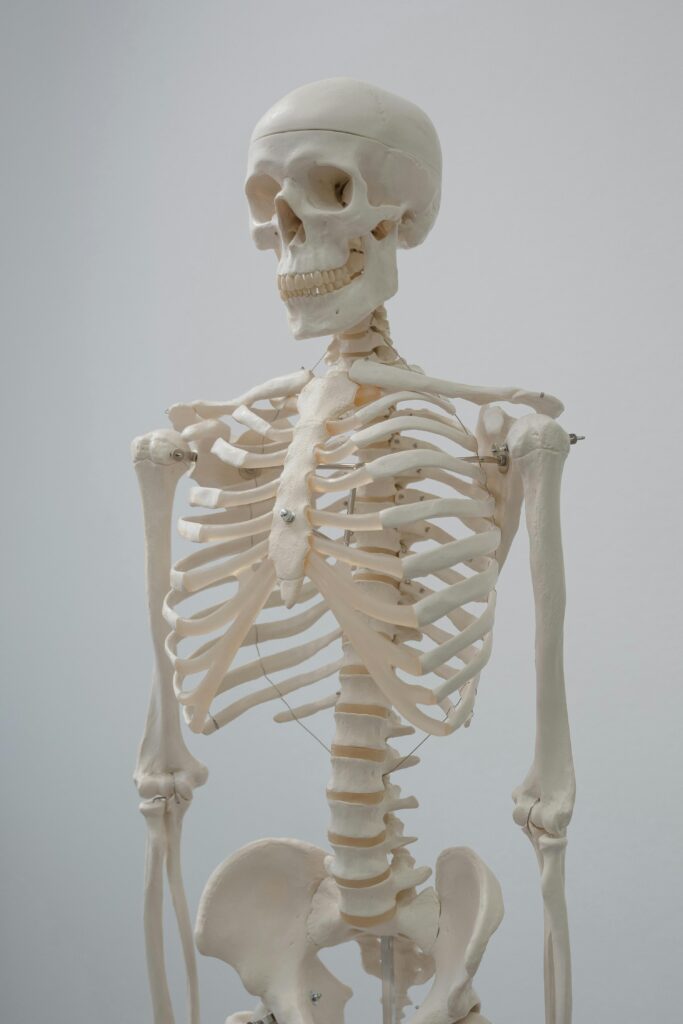
Living bones contain a substantial amount of collagen, which gives them a leather-like texture and flexibility. This combination of materials creates an incredibly efficient structure:
- Mineral salts help bones withstand compression forces
- Collagen fibers provide resistance against tension that could otherwise fracture the bone
If bones were composed only of mineral salts, they would shatter easily under pressure—imagine how a dry, dead tree branch snaps when stepped on. However, the collagen in our bones makes them behave more like a living tree branch, which bends and flexes under external pressure rather than breaking.
Internal Architecture
The inside of our bones features a remarkable porous structure that allows them to be both lightweight and incredibly strong. This internal framework is called trabecular bone or spongy bone, and it’s significantly more elastic than the harder outer layer of bone, known as cortical bone.
The trabecular bone is particularly fascinating because it’s:
- More prone to remodeling and adaptation
- More metabolically active
- Constantly responding to the stresses we place on our bones
Function-Specific Design
The ratio between cortical and trabecular bone varies throughout the body, perfectly matched to each bone’s specific function:
Non-Weight-Bearing Bones (like ribs):
- Contain much higher trabecular content
- Prioritize flexibility and protection over load-bearing
- Allow for expansion during breathing and movement
Weight-Bearing Bones (like leg bones):
- Feature much more cortical bone
- Built to support the full weight of the body
- Designed for stability and strength under compression
This understanding of bone composition helps us appreciate why gentle, sustained yoga poses are so beneficial for bone health, providing the right balance of stress and flexibility to keep our skeletal system strong and resilient.
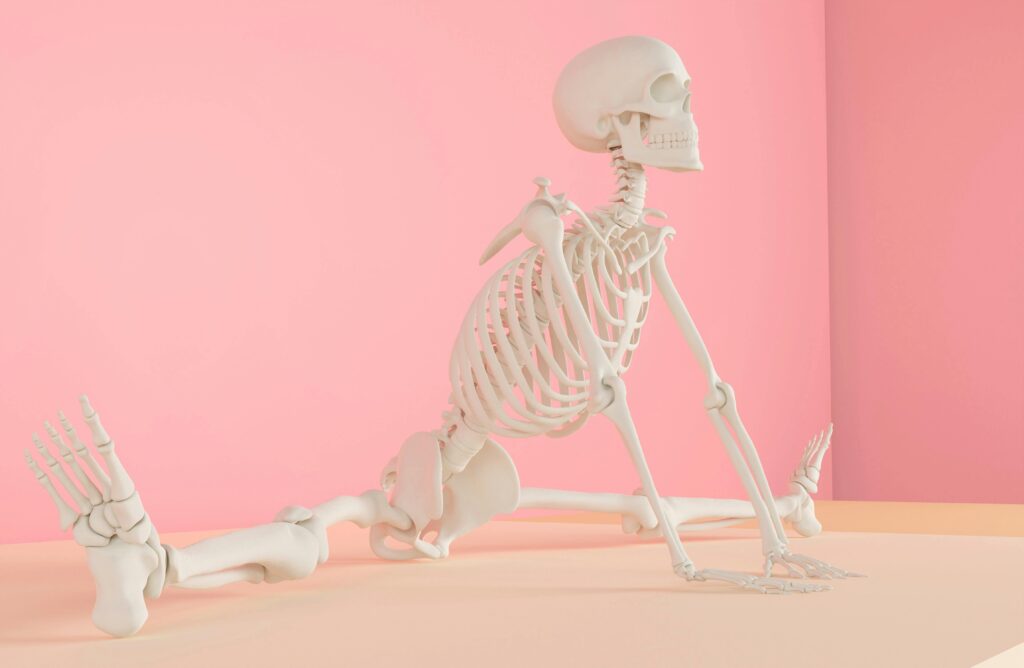
Cartilage
Cartilage, like bones, supports tissues and provides structure and firmness to the body. This connective tissue is fairly firm yet rubbery and more flexible than bone. Typically appearing white or bluish-white, cartilage has a smooth, almost glass-like surface in healthy joints.
The cells within cartilage, called chondrocytes, produce the extracellular matrix that gives cartilage its distinctive firm yet flexible nature. This matrix contains large chemical compounds called proteoglycans that have a remarkable ability to attract and retain water—a key factor in cartilage’s shock-absorbing properties.
Primary Functions of Cartilage
Protection and Cushioning
Cartilage acts as the body’s natural shock absorber, cushioning joints and protecting bones from the impact of daily activities. In yoga, this cushioning allows us to move fluidly between poses without bone-on-bone contact.
Joint Formation
Cartilage forms the smooth surfaces of synovial joints, enabling frictionless movement. This is why well-maintained cartilage allows for the graceful transitions we see in advanced yoga practitioners.
Structural Support
Cartilage provides the foundational structure for various body parts, including:
- The nose and ears
- The larynx (voice box)
- The ribcage connections
- The intervertebral discs of the spine
Bone Development
Many bones begin their existence as cartilage during fetal development. Through a process called ossification, this cartilage template gradually transforms into mature bone tissue.
Ligaments
Ligaments serve as the body’s binding system, connecting bones together and maintaining joint stability. These remarkable structures come in various shapes—cords, sheets, and bands—each perfectly designed for their specific function.
Ligaments have a darker color compared to other connective tissues, due to their composition of elastin and finer collagen fibers. This unique makeup allows them to be pliant and flexible in directions where they don’t need to restrict movement, while providing firm support where stability is crucial.
Key Characteristics
Ligaments possess an ideal combination of qualities for joint protection:
- Strong and tough enough to withstand tremendous forces
- Pliable enough to allow natural joint movement
- Mostly inelastic to prevent excessive joint motion that could cause injury
To put their strength in perspective, the iliotibial band running down the outside of your thigh is robust enough to support the weight of a car without snapping!
Ligament Variability Throughout the Body
Not all ligaments are equally rigid—their flexibility depends on their elastin-to-collagen ratio:
Highly Elastic Ligaments
- Lumbar spine ligaments: The most flexible ligaments in our bodies
- Neck (cervical) ligaments: Designed for the wide range of head movements
- These ligaments contain higher proportions of elastin than collagen
More Rigid Ligaments
- Found in weight-bearing joints like knees and ankles
- Contain higher collagen content for maximum stability
Age-Related Changes and Modern Lifestyle Impact
As we age, elastin fibers undergo significant changes:
- They become mineralized and cross-linked with other fibers
- This process makes them progressively stiffer
- Range of movement becomes increasingly restricted
This aging process is particularly problematic for our lower back ligaments. When combined with prolonged sitting—a reality for many of us working at computers all day—these ligaments become especially stiff and restrictive. This stiffness is a primary contributor to the epidemic of lower back pain in our sedentary society.

Stretching Ligaments and Tendons: Understanding Plastic vs. Elastic Tissues
The Critical Difference: Plastic vs. Elastic
Ligaments and tendons are fundamentally plastic rather than elastic tissues. This distinction is crucial for safe practice:
Plastic Tissues (Ligaments & Tendons):
- When overstretched, they remain in their new, lengthened shape
- Do not quickly recover their original form
- Require careful, controlled stretching to avoid permanent deformation
Elastic Tissues (Muscles):
- Can be stretched considerably and still revert to original shape
- Bounce back relatively quickly after stretching
- More forgiving of vigorous stretching
Safe Exercise Principles for Plastic Tissues
Understanding this difference means we must approach ligaments and tendons differently than muscles. This doesn’t mean we shouldn’t exercise these tissues—quite the opposite. We simply need to do so with greater care and awareness to avoid exceeding their natural limits.
This is where Yin Yoga becomes our greatest ally.
Connective Tissue and Yin Yoga
The Importance of Appropriate Stress
Stressing our body appropriately is essential for maintaining health. Bones need stimulation to remain strong, as do ligaments and fascia. While the simple act of walking provides great benefits for the legs, pelvis, and spine, Yin Yoga offers another way to provide this beneficial stress in an intelligent, safe, and targeted manner—being especially effective for the lower back and legs.
How Yin Yoga Benefits Connective Tissue
Cellular Stimulation
Yin Yoga stimulates the growth of fibroblasts—the cells responsible for creating collagen, elastin, and the water-loving molecules that hydrate our tissues and joints.
Structural Strengthening
Through sustained, gentle pressure, Yin Yoga helps make our ligaments thicker and stronger by promoting greater collagen production.
Cartilage and Bone Health
Yin Yoga effectively stimulates chondrocytes and osteoblasts—the cells that create cartilage and bone respectively—helping to reduce degeneration of these vital tissues.
Enhanced Lubrication
The practice aids lubrication production through greater hydration of our tissues, allowing joints to move more freely and fascia to slide more easily.
The Yin Yoga Advantage
Unlike more dynamic forms of yoga that primarily target muscle flexibility, Yin Yoga’s long-held, passive poses create the ideal conditions for:
- Safe plastic tissue adaptation
- Deep connective tissue hydration
- Gentle stimulation of cellular repair processes
- Systematic strengthening of our body’s structural framework
This makes Yin Yoga an invaluable complement to more active practices, ensuring we maintain the health of our entire musculoskeletal system throughout our lives.
Apply this principles into your practice
Ready to experience these principles firsthand? Join me in this specially designed 65-minute Yin sequence that targets the key areas we’ve discussed—your spine, hips, and legs. This practice incorporates everything we’ve learned and aims for you to be able to experience these benefits in your own body.
In this practice, I’ll guide you through each pose while explaining exactly how it benefits your connective tissues. You’ll leave with not just a deeper stretch, but a deeper understanding of your body’s remarkable capacity for adaptation and healing.
Remember: every moment you spend in these poses is an investment in your body’s long-term health and mobility. Let the science inspire your practice, and let your practice prove the science.
Stay tuned for the next entry in our yoga blog , and subscribe to my newsletter.
The Science Behind Stillness: How Yin Yoga Rewires Your Body | Part 2
Following up on my latest yin yoga article, I’ll delve deeper into how Yin Yoga…

Asana Encyclopedia. Vrikshasana (Tree Pose): Meaning, Alignment & History.
Today, I’ll unpack what Vrikshasana (Tree Pose) means in Sanskrit and share the story and…

The magic of Stillness: Yin Yoga Rewires Your Body | Part 1
Ever wonder why you wake up feeling like a rusty robot, or why that forward…
Yoga Anatomy Series | Part 1: Understanding Body Language & Movement Planes
As a yoga teacher, I understand the struggle of completing your 200-hour YTT —and sometimes…

How to survive your first yoga class?
Following up on the subject of how to get ready for your first yoga class,…
Asana Encyclopedia. Tadasana (Mountain Pose): Meaning, Alignment & History.
I’m going to break down what Tadasana (Mountain Pose) means in Sanskrit and also tell…