
As a yoga teacher, I understand the struggle of completing your 200-hour YTT —and sometimes even your 500-hour YTT— only to realize you don’t know enough anatomy to feel truly confident teaching. Then begins the quest for resources to deepen your understanding…
That’s why I’m creating this series of articles: to share the fundamentals of anatomy specifically for yoga teachers. I’ll keep it as accessible and practical as possible, so you can actually apply this knowledge in your classes and in your own practice.
In this first post, I’ll break down what anatomy, physiology, kinesiology, and biomechanics actually mean —so we can start with a shared vocabulary. After that, I’ll introduce the anatomical position and the planes of movement in the body.
Let’s begin.
Anatomical definitions & why are they important for you as a yoga teacher?
Anatomy
Put simply, anatomy is the study of the structure of the human body.
It includes questions like:
- What are the parts of the body? (f. ex. joints, muscles, bones, connective tissue).
- What do these parts look like?
- What are they called?
Notice that, even when a big part of anatomy is naming and studying specific body parts, our bodies are not a collection of separate body parts but an integral whole. In yoga, we want to understand how do these part work together and how to they express themselves in our bodies.
Physiology
Physiology refers to how the body functions, usually at the cellular or systemic level.
It asks questions such as:
- How muscles contract?
- How breathe affects our state?
- How the nervous system relates to movement?
In yoga, physiology connects us to the deeper processes happening inside the body during practice: like breath, heart rate, and the rest-and-digest response.
Kinesiology
Kinesiology is the study of how the body moves (f. ex. what muscles are involved in a pose, and what types of motion occur at each joint?)
In yoga, kinesiology helps us understand:
- Which muscles activate in a pose?
- How joints move in different asanas?
- How to cue movement safely and effectively
Biomechanics
Finally, biomechanics applies the laws of physics to the movement of the body.
It looks at things like:
- How we can move more efficiently?
- How gravity, resistance & momentum affect the body?
- How can we avoid injuries by aligning the body?
Why is anatomical knowledge important for yoga teachers?
Yoga means union and as yoga teachers, we’re constantly reminded that everything in the body and mind is interconnected. While asana is only one small part of yoga, every practice —whether it’s pranayama, meditation, or pratyahara— is ultimately embodied.
In other words, every breath we take, every thought we have, and every movement we make is only possible because we have a body.
That’s why understanding how the different parts of the body work together —in an integrated and holistic way— can help deepen your comprehension of yoga itself.
This doesn’t mean you need to memorize every single muscle or bone in the body (though if you’re curious and want to, that’s wonderful!). What I’m really trying to convey is that having a functional understanding of how the body works as a whole can make a big difference in how you teach.
It can help you understand:
- Why certain movements are easier for some bodies than others
- Why specific alignment cues may not work for every student
- How, even though we all share the same basic structure, each body is unique
- How to honor and address those differences in the context of a yoga class
So, as we progress through this series, don’t stress about learning every complex anatomical term. The real value lies in understanding how these elements come together in your body, so you can move, teach, and guide others with more awareness and confidence.
Anatomical terminology helps us speak clearly and precisely about the body, which is why having a basic understanding of it is so important.
Now, this isn’t the language you’ll use while teaching, but learning it gives you a clear framework for analyzing body positions and movements. From there, you’ll have the tools to translate that understanding into everyday language your students will relate to.
Being familiar with this terminology also makes it easier to understand anatomy resources —like manuals, courses, or diagrams— and communicate more effectively with medical professionals, who regularly use this vocabulary.
Anatomical Position
The first thing to know is that all anatomical terms are based on a reference position called the anatomical position, or Tadasana, in yoga terms.
This reference point helps us understand how different parts of the body relate to one another, and how those relationships change when we move.
Having a shared reference position makes it possible to describe any body part accurately, no matter what position the body is in.
Anatomical Position or Tadasana (with palms facing forward)
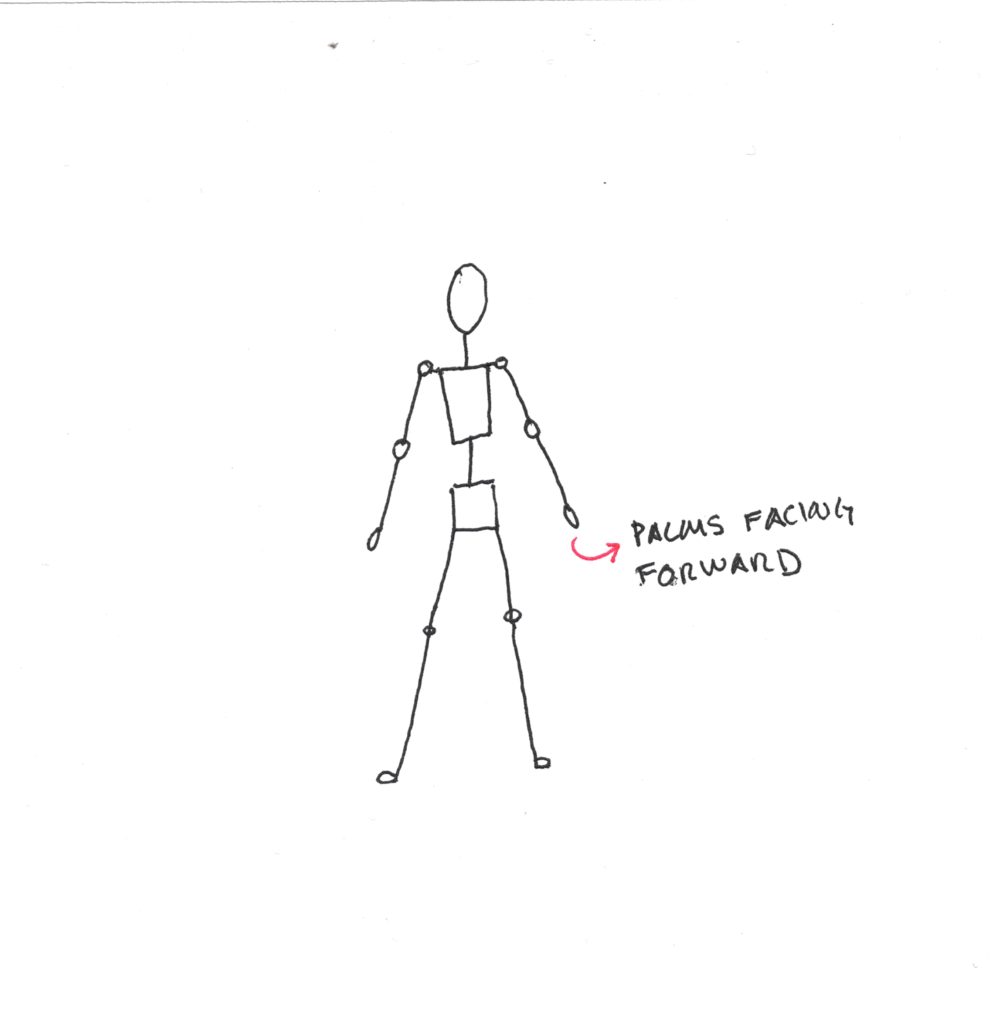
Why are the palms facing forward in anatomical position?
You might wonder this —especially since in Tadasana, palms are usually facing in toward the body.
Here’s why:
We have two bones in our forearms — the radius and the ulna.
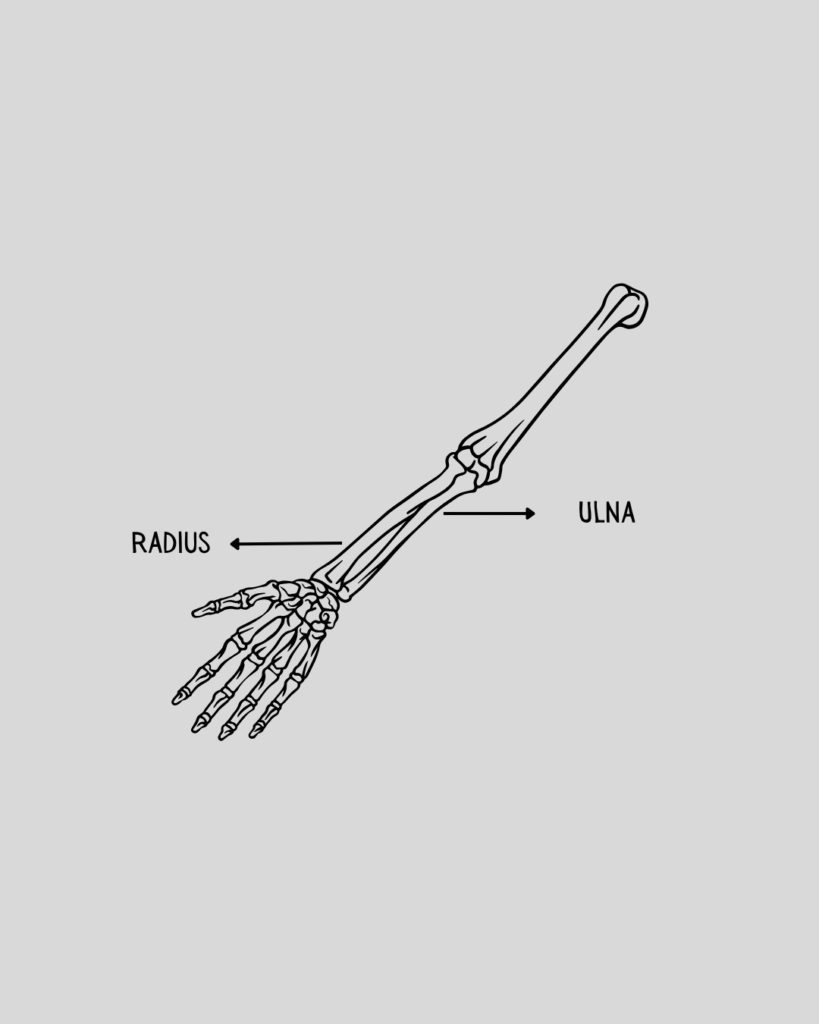
The radius is on the thumb side, and the ulna is on the pinky side. When you stand with your palms facing forward, these two bones lie side by side, parallel to each other.
This parallel alignment allows us to describe their relationship clearly. In this position:
- The radius is lateral (closer to the outside of the body)
- The ulna is medial (closer to the midline)
But when you turn your palms backward, the radius crosses over the ulna, making it harder to define which bone is medial and which is lateral.
So, keeping the palms forward makes it easier to identify these relationships. That’s the main reasons this position was chosen as the standard anatomical position.
Planes of movement
Planes of movement are useful for describing and analyzing movement. They help us name the movements of the body precisely in relationship to an abstract three-dimensional space, and there are three of them.
Sagittal Plane
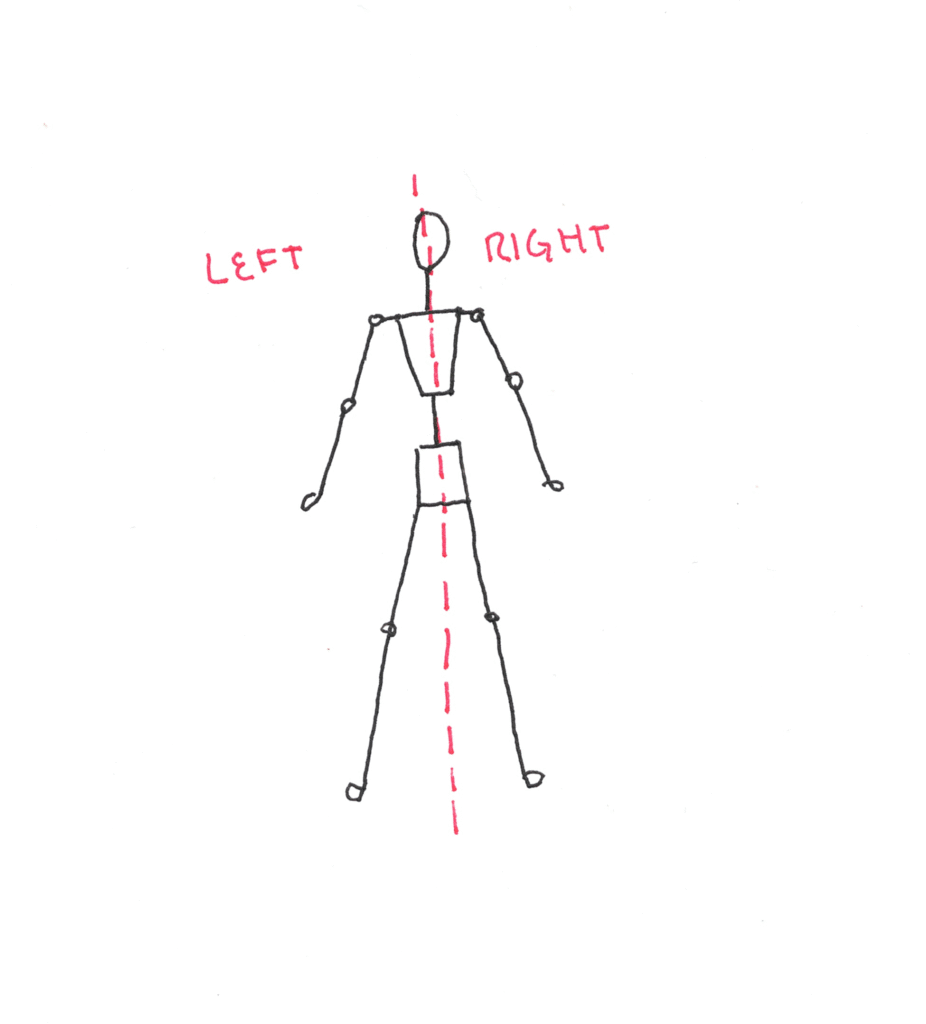
The sagittal plane divides the body into right and left halves.
Technically, the one shown above is a mid-sagittal plane, since it runs right down the center of the body 🙂
In this plane FORWARD & BACKWARD movement happens.
For example:
- Folding forward at the hips (like in Uttanasana).
- Arching your back (like in Cobra Pose or Wheel).
But why is it called the sagittal plane?
The word sagittal comes from “sagitta,” which means arrow in Latin. Think Sagittarius, the archer. It’s the plane in which you’d shoot an arrow straight forward.

Frontal or coronal plane
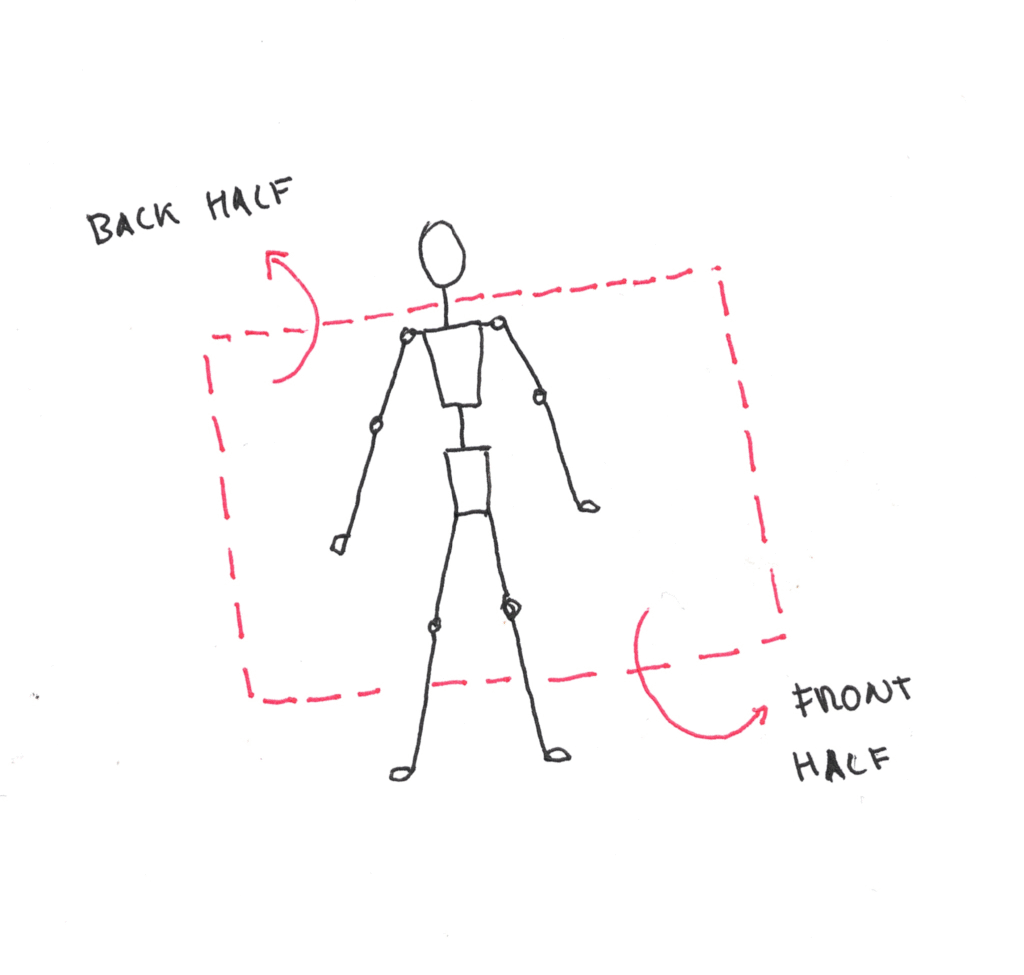
The frontal (or coronal) plane divides the body into front and back halves.
In this plane, SIDE-TO-SIDE movement happens.
For example:
- Imagine you’re standing between two walls, just wide enough for your body to fit. Any movement you can make within that narrow space —like moving your arms or legs out to the sides, or bending your spine sideways— happens in the frontal (or coronal) plane.
Now, why is it called the coronal plane?
The word coronal comes from corona, meaning crown. Imagine wearing a tiara or a crown —or, for a more modern visual, a pair of headphones :). The line they create across the top and sides of your head defines the coronal plane.
Transverse plane
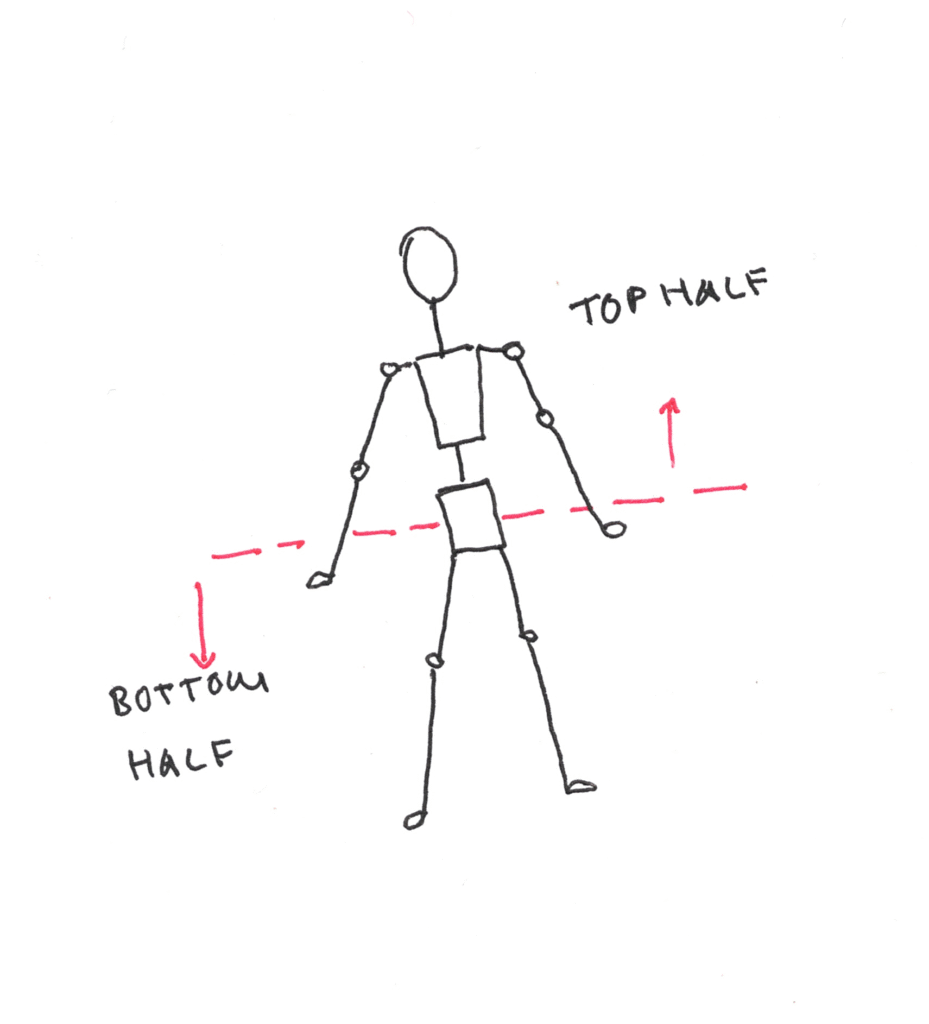
The transversal plane divides the body into a top and a bottom halves.
In this plane, TURNING or ROTATIONAL movements happen.
For example:
- Any twist of the spine —like in Revolved Triangle or Seated Spinal Twist— or even turning your head to look over your shoulder.
It is called transversal precisely because the word transverse means running across, or horizontally, and this plane mimics that shape.
Going beyond planes of movement: multi-planar movement!
While this is a helpful conceptual framework for understanding movement in the body, it’s important to remember that real-life movements rarely happen in just one plane.
Fortunately, we’re not robots! We don’t only move side to side or front to back. Most of the time, we move through multiple planes at once in a dynamic, integrated way.
In the next article, we’ll explore the terms of movement associated with each cardinal plane, so you can start naming and understanding how these movements show up in your yoga practice.
Stay connected by subscribing to my newsletter and having every article delivered to your e-mail:
The Science Behind Stillness: How Yin Yoga Rewires Your Body | Part 2
Following up on my latest yin yoga article, I’ll delve deeper into how Yin Yoga…

Asana Encyclopedia. Vrikshasana (Tree Pose): Meaning, Alignment & History.
Today, I’ll unpack what Vrikshasana (Tree Pose) means in Sanskrit and share the story and…

The magic of Stillness: Yin Yoga Rewires Your Body | Part 1
Ever wonder why you wake up feeling like a rusty robot, or why that forward…
Yoga Anatomy Series | Part 1: Understanding Body Language & Movement Planes
As a yoga teacher, I understand the struggle of completing your 200-hour YTT —and sometimes…

How to survive your first yoga class?
Following up on the subject of how to get ready for your first yoga class,…
Asana Encyclopedia. Tadasana (Mountain Pose): Meaning, Alignment & History.
I’m going to break down what Tadasana (Mountain Pose) means in Sanskrit and also tell…