
Ever wonder why you wake up feeling like a rusty robot, or why that forward fold that felt easy in your early twenties now seems impossible?
The answer lies deep beneath your muscles, in a web-like tissue system that most people have never heard of—yet it controls how flexible, mobile, and pain-free you feel every single day.
As a continuation of my latest yin yoga article, I’m about to reveal exactly what’s happening inside your body when you hold those long, slow yin yoga poses. Spoiler alert: it’s way more fascinating (and beneficial) than you think.
Following Bernie Clark’s framework, the benefits of practicing Yin yoga can be organized into three major areas: physical, energetic, and mental/emotional. While there are also spiritual benefits that any yoga practice provides, the ways these practices can assist us vary greatly and operate on many different levels. I’ll save that realm for a different occasion—hopefully to offer a platform for discussion and sharing within this community.
In this series of articles, I’ll look into the ways in which Yin Yoga rewires your body to give you a comprehensive anatomical guide to which you can always return if needed.
Today, we’ll look into what exactly happens inside your body during asana practice, provide a general overview of what tissues are, offer a definition of flexibility and range of motion, and finally we’ll delve into one of the tissues that receives the most benefits from yin practice: the fascia ecosystem.
What happens to your body during asana practice?
The tissues of our body are stressed in three different ways during asana practice:
- Compress: causing tissues to press together.
- Stretch: causing tension and lengthening.
- Twist: causing shear forces
For instance, when we practice backbends (such as upward facing dog or cobra), we compress the facets of our vertebrae into each other. On the other hand, in forward folds (the exact opposite movement), we stretch the fascia and muscles along the back of the spine. In twists, we apply a shearing force between the vertebrae and the ribs, which leads to both compression and stretch of the tissues around the ribs.
The sponge metaphor
The result of these stresses affects the body in a positive way on many levels. Think of how you might rescue that sad, crusty kitchen sponge that’s been abandoned under the sink for months—you know, the one that’s basically become a science experiment. Soak it in warm water and give it the full spa treatment: twist it, squeeze it, stretch it until all those grunky bits (we won’t ask what they are) get flushed out by the water.
I realize comparing your beautiful body to a neglected dish sponge isn’t exactly flattering, but hear me out: asana practice works like the ultimate internal spa day for your tissues. Except instead of questionable kitchen grime, you’re releasing tension, toxins, and that weird stiffness from sitting at your desk pretending to work while actually scrolling social media. By the way, if you were wondering where does our warm water come from, it is embodied by our blood and lymphatic fluids.

Asana practice promotes the flow of energy within the body, stimulating both energy release (during active yang practices such as Vinyasa or Ashtanga) and the removal of deep blockages to this flow (particularly during yin practices). This liberation of energy blocks allows the energy to move freely inside your body, creating deeper nourishment.
General overview of our tissues
Our bodies are a complex ecosystem made up of many types of tissues that respond differently to movement. As I already stated in our last yin article, Yin Yoga is particularly effective in working with the deeper connective tissues of the body. Moreover, to fully understand its benefits, we need to look at the nature of these tissues.
First of all, what are tissues?
Tissues are aggregations (communities) of cells inside our bodies that have a similar purpose and arrangement, so they are classified as the same type. We can usually speak of four different main kinds of tissues:
- Epithelia (skin is the largest and most known of them).
- Nervous
- Muscle (including fascia)
- Connective (joint capsules and ligaments)
We usually think that physical exercise only engages the last two. However, every time we move, we are actually engaging our muscles to create movement, and every movement stretches, twists, or compresses all of the tissues of a particular area as well as areas farther away (remember that we are an intertwined ecosystem). Therefore, movement and yoga affect the whole body and all of its tissues.
You now might be asking yourself, then what prevents us from going further into a pose? Flexibility: an often simplified concept that we’ll examine more deeply right away.
What’s Really Stopping You From Going Deeper?
Now that we know that any movement we engage with during our physical yoga practice either stretches the tissues, compresses them, or applies shear to them, we can understand what stops us from going deeper into any position. The limitation of our flexibility is dictated by the resistance (or tension) from our tissues to being further elongated or compressed. Both things happen when two parts of the body come into contact and prevent further movement.
Now:
- If tension is preventing the movement, it is felt in the direction away from the movement. For example, if you are sitting in Dandasana (Staff Pose) and transition to Paschimottanasana, and you can’t touch your feet, heels, or calves, you’ll probably be experiencing tension in the hamstrings or lower back.
- If compression is stopping the movement, it is felt in the direction of the movement. For instance, in the same position, compression may occur when the hip flexors are squeezed against your abdomen while folding forward.
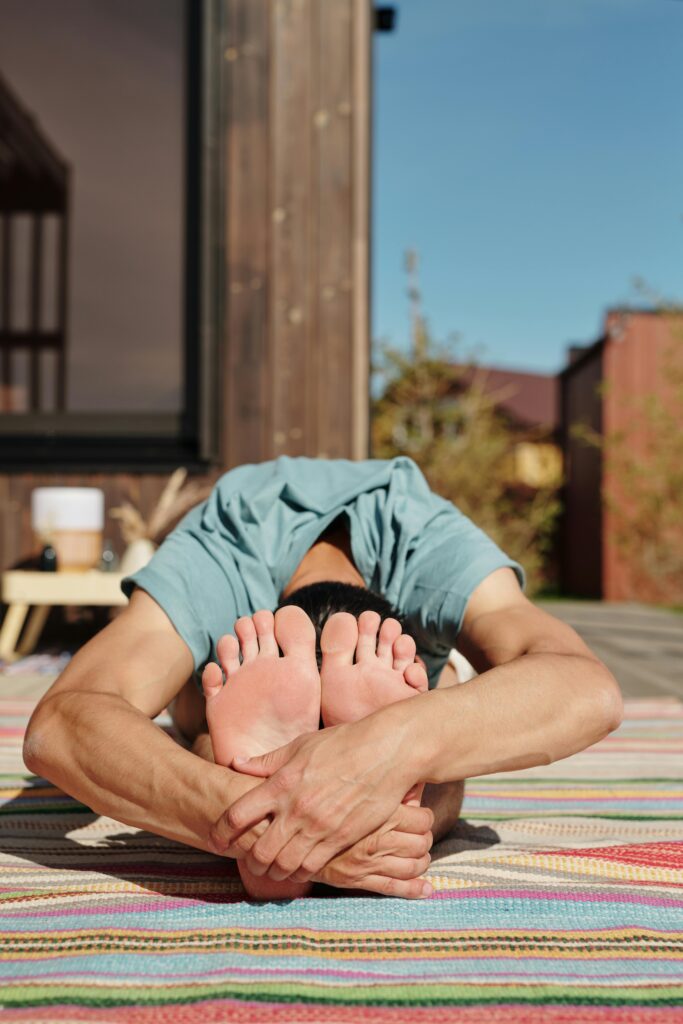
In several cases, finding the root of what is preventing us from going deeper into any pose is not so easy to determine. That’s why yoga teachers tend to repeat so many times the importance of maintaining mind-body awareness during practice. By paying attention to the sensations that arise within us while we practice, we slowly become better at identifying what is causing us to stay within a specific range of motion (and work on it, if we wish to go further).
The Two Types of Flexibility Blocks (And Why It Matters to your yoga practice)
On the other hand, the range of motion (ROM) we have in our joints, when limited by tension, can be increased and improved through asana practice, pranayama, and diet changes. However, when the limit to the ROM has been reached and compression is stopping further movement, no amount of practice will increase it because the physical structures are simply in the way.
The point of compression varies depending on specific life circumstances and body structure. Think, for example, of a pregnant woman in her last trimester. She may not be able to fold forward in Paschimottanasana and touch her toes due to compression between her belly and legs. However, after she gives birth, the point of compression would change and her range of motion in that direction will increase.
Understanding this difference between tension and compression helps us approach our practice with realistic expectations and safety.
ROM TENSION LIMITATION
Going back to the case in which ROM is restricted by tension, it has been found that this usually comes from four main tissues: the skin, the tendon of the muscle, the muscle (and its fascia), and the joint capsule and its ligaments. All of them provide resistance to movement. The following table (reproduced from Clark’s book The Complete Guide to Yin Yoga) shows how resistance is distributed in these 4 areas:
| Joint capsule & ligaments | 47% |
| Muscle (and fascia) | 41% |
| Tendon | 10% |
| Skin | 2% |
By looking at the chart, we immediately notice that the biggest limit to flexibility is the joint capsule’s rigidity, followed very closely by the muscles and their fascia.
With this understanding, we can begin to see why combining yang and yin practices is the best path to increase general mobility and flexibility.
- On one hand, yang yoga increases the ROM of the muscles and skin.
- On the other hand, yin yoga is a safe way to gently stress the joints and ligaments to their healthy limits over time, and to lengthen our fascia.
Types of Tissues
So…. Yin yoga helps us increase the mobility of our fascia.
Now, you might be asking yourself, well what exactly is fascia?
I’ve got you, but get ready to get anatomically technical!
Fascia
Myofascia
Fascia means “band” or “bandage” in Latin and it refers to the integrating mesh that envelops our bones, muscles, and organs. Think of it as a wrapping plastic bag that holds our muscle groups together. Within this big outer plastic wrapper, each individual muscle also has its own plastic bag. Every one of our muscles is wrapped in fascia, and it can make up to 30% of their mass. Also, our blood vessels and nerves are held in place due to the support and structure of the fascia.
It goes something like this:
Major muscle group (with its respective wrapping paper) → Smaller groups of muscles (with their own fascia) → Individual muscle (fascia) → Muscle fiber (fascia).
Fascia is made up of collagen, elastin, and reticular fibers, and it’s primarily a yin tissue. This means that it responds best to yin stresses. Long-held stretches will help reorganize the fascia and allow it to become longer and thicker.
While yang practices help us strengthen our muscle fibers, yin allows us to lengthen them. Remember that both practices complement each other and are necessary to create balance within the body 🙂
Superficial Fascia & Deep fascia
However, fascia is ubiquitous and found all over the body. Besides our muscles, it also includes:
- Ground substances, made up of extracellular fluids that create pools of watery gel through which cells can migrate.
- Living cells, such as fibroblasts, as well as the molecules that attract and hold water in place.
Fascia varies in thickness and density depending on where it is and what it is being used for. For instance, we have a type of fascia just beneath the skin (called superficial fascia or hypodermis) and another type right beneath it known as deep fascia, which is tougher and tighter than the other one. Embedded inside this layer are the tissues of the muscles, the blood vessels, and all of the other tubes that wind through the body.
Deep fascia merges with all the other tissues embedded within, creating the complex and intertwined ecosystem of our bodies. It binds the muscles together, transmits the forces applied to the muscle evenly, and lubricates the various surfaces of the muscles. Fascia connects our muscles and organs and is also connected to the whole fascial system.
This interconnection means that a small movement in one area of the body pulls on the whole web of fascia throughout the body. This is what allows us to feel even the smallest movement at one end of the body at the other end (if we pay enough attention, naturally).
Why Your Fascia Gets Stuck (And How Yin Yoga Fixes It)
Fuzz
As I noted earlier, one of the functions of fascia is to allow the sliding surfaces of adjacent muscle groups to slide. When the fascia becomes too dry, those sliding surfaces will begin to stick together, limiting our mobility.
These adhesions are made of collagen fibers and are created when we remain still. For instance, every time we go to bed, our body produces fuzz between our muscle groups, and when we wake up and begin moving, we break that fuzz. However, if you are immobilized, injured, or have an extremely sedentary life, the fuzz will not be broken, compromising your range of movement in the medium and long term. As time passes by, the fuzz becomes thicker and thicker, and the range of motion is considerably reduced.
Yoga practice helps us move the body in many different ways, which helps us break down the fuzz in more areas of the body.
If you wish to see an explanation on fuzz with a human body, click Gild Hedley’s video below. It has images that might be impactful, be aware when watching it.
Myofibroblasts
Myofibroblasts are also responsible for restrictions in our fascial range of movement. They are living cells constituted as contracting fibers that, when concentrated in high density (especially common in the lumbar fascia), might lead to tissue remodeling (including shortening of the muscle fibers), chronic instability of the area, headaches, and even fibromyalgia.
Yin yoga (along with acupuncture) is one of the best treatments to reduce the symptoms of these pathologies and correct the excessive distribution of the myofibroblasts.
Summary
Throughout this post, I gave you an overview of what flexibility means, and I began to list the benefits that a consistent yin practice might provide you. We looked into the complex ecosystem of fascia and how it interacts with yoga practice in general and with yin yoga in particular. This summary lists the main benefits we discovered today:
- Improves our flexibility and range of motion.
- It passively lengthens our muscles through stretching the fascial wrapping bags around our muscle fibers. This process is especially beneficial for the larger muscle groups such as the hamstrings and adductors.
- It reduces adhesions within the fascia, which restrict movement between the sliding surfaces of our muscles.
- It stimulates the growth of fibroblasts (the cells responsible for creating collagen, elastin, and the water-loving molecules that hydrate our tissues and joints).
- It reduces the hyper-concentration of myofibroblasts, which helps us increase the length of complicated muscles (for example, the quadratus lumborum).
Invitation
Ready to experience these fascial benefits firsthand? Start with your yin practice tonight. I’ll leave you one of my classes below for you to have an option to begin with 🙂
Have you felt the interconnected web of fascia during your practice? I’d love to hear about your experiences in the comments below. And if this deep dive into the science behind yin yoga resonated with you, share it with a fellow practitioner who might appreciate understanding the “why” behind their practice.
Next week, we’ll explore how Yin yoga affects our joints and ligaments. Subscribe to never miss an article in this series!
The Science Behind Stillness: How Yin Yoga Rewires Your Body | Part 2
Following up on my latest yin yoga article, I’ll delve deeper into how Yin Yoga…

Asana Encyclopedia. Vrikshasana (Tree Pose): Meaning, Alignment & History.
Today, I’ll unpack what Vrikshasana (Tree Pose) means in Sanskrit and share the story and…
The magic of Stillness: Yin Yoga Rewires Your Body | Part 1
Ever wonder why you wake up feeling like a rusty robot, or why that forward…
Yoga Anatomy Series | Part 1: Understanding Body Language & Movement Planes
As a yoga teacher, I understand the struggle of completing your 200-hour YTT —and sometimes…

How to survive your first yoga class?
Following up on the subject of how to get ready for your first yoga class,…
Asana Encyclopedia. Tadasana (Mountain Pose): Meaning, Alignment & History.
I’m going to break down what Tadasana (Mountain Pose) means in Sanskrit and also tell…
Pingback: The Science Behind Stillness: How Yin Yoga Rewires Your Body | Part 2