
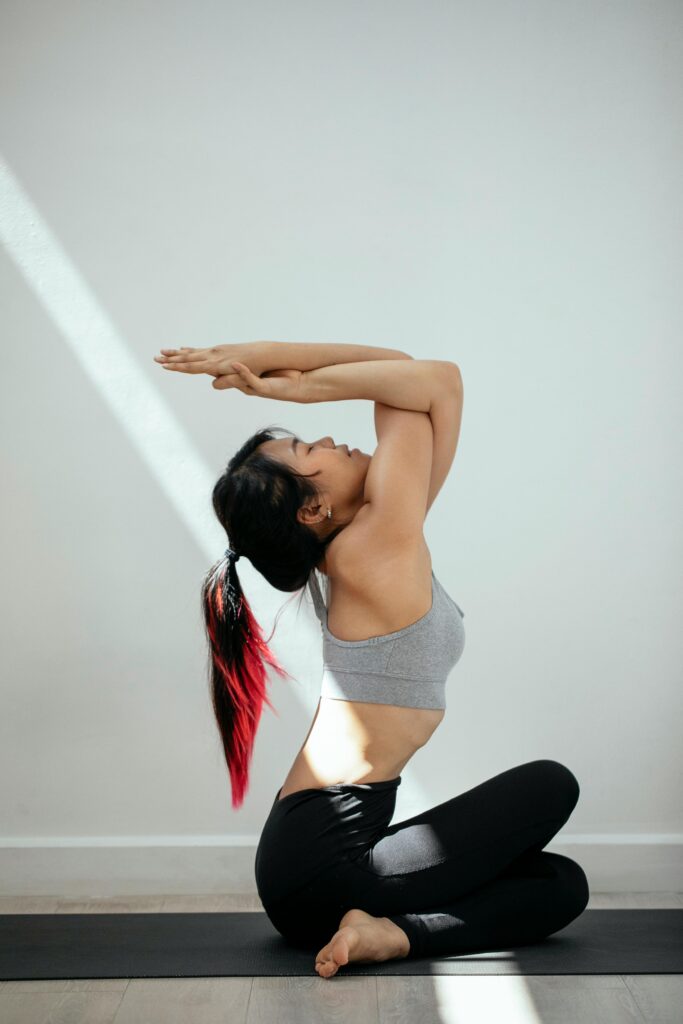
In this article, I’ll break down the meaning of Gomukhasana (Cow Face Pose) in Sanskrit and explore the story and symbolism behind its name. You’ll also find key alignment cues to help you teach or practice this pose with greater clarity and intention.
This post is part of a series created for yoga teachers and curious practitioners who find it challenging to memorize Sanskrit pose names. You can check out the previous article here!
What does Gomukhasana mean?
The name of this pose is derived from its shape, which—for some (definitely imaginative yogis)—resembles the face of a cow.
It comes from three Sanskrit roots:
Go (cow)
Mukh (face)
Asana (posture)
Symbolism of Gomukhasana
Cows are one of India’s most sacred animals—and they know it. They rule the roads like royalty. If you’ve ever seen street footage from an Indian city, you’ll quickly spot them: calm, majestic, and completely unbothered, weaving through buses, cars, and motorcycles like they own the place (because, honestly, they kind of do). Drivers twist, turn, and swerve around them in already chaotic traffic, as if navigating a sacred obstacle course. Traffic laws? Physics? Mere suggestions. Cows don’t follow rules—they make their own.
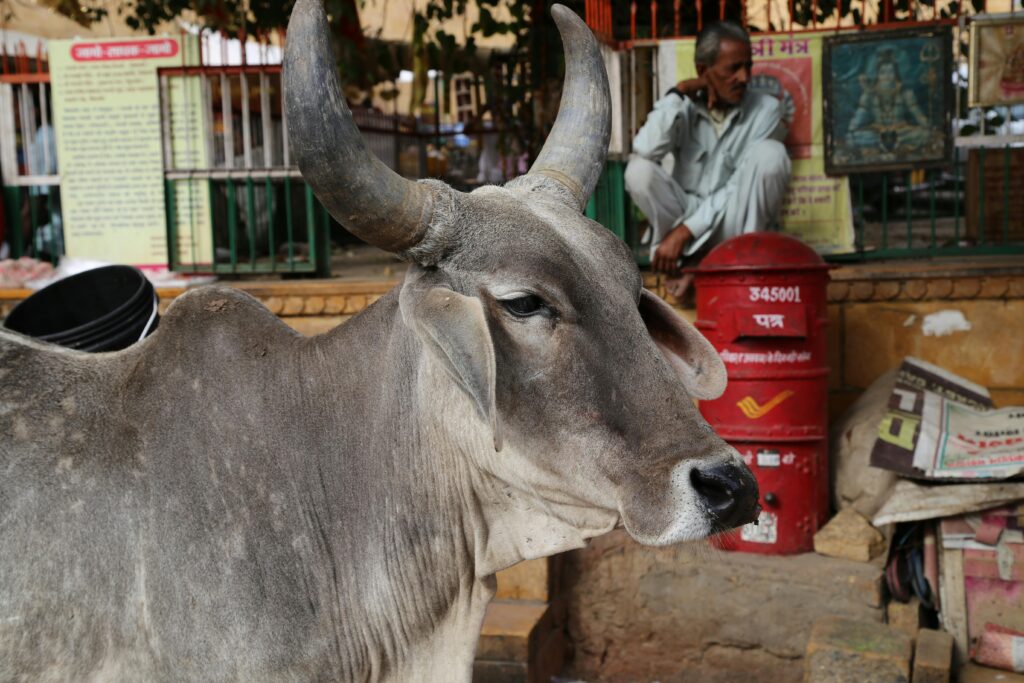
In yogic tradition, cows embody a wealth of positive qualities. They’re down to earth. They’re also noble, generous, and naturally nurturing—when a cow sees her calf, her milk flows freely and abundantly.
For many yogis, this tender bond between mother and child symbolizes the relationship between the Earth and all its inhabitants. In an eternal cycle—one that sadly seems disrupted by our modern, more predatory ways—we’re meant to offer the Earth our love and gratitude, while using her gifts with care and sustainability.
Alignment & Cues for Gomukhasana
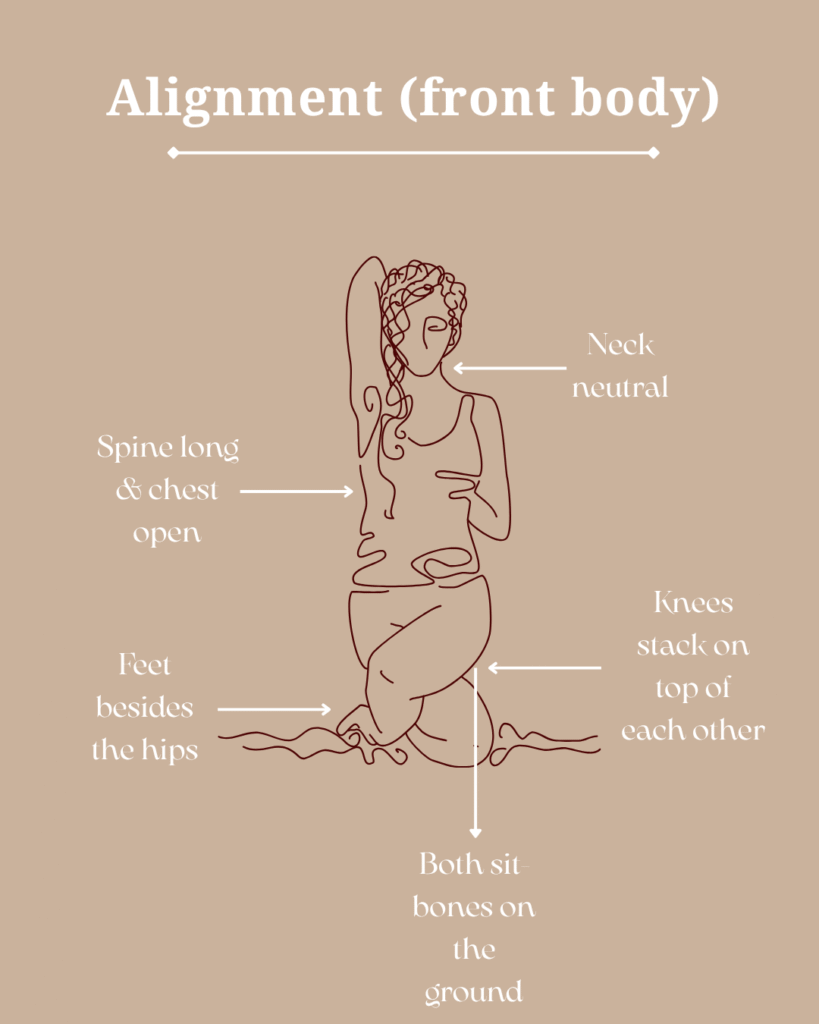
- Sit tall with your legs extended in front of you. Take a moment to ground through your sitting bones and lengthen your spine.
- Bend your knees and slide your left foot under your right thigh, bringing the left heel toward your outer right hip.
- Then cross your right leg over the left, stacking the right knee on top of the left. The right foot should come beside the left hip.
- Both sitting bones should be grounded evenly. If one hip lifts, adjust your props or leg positioning. Keep the spine long and neutral.
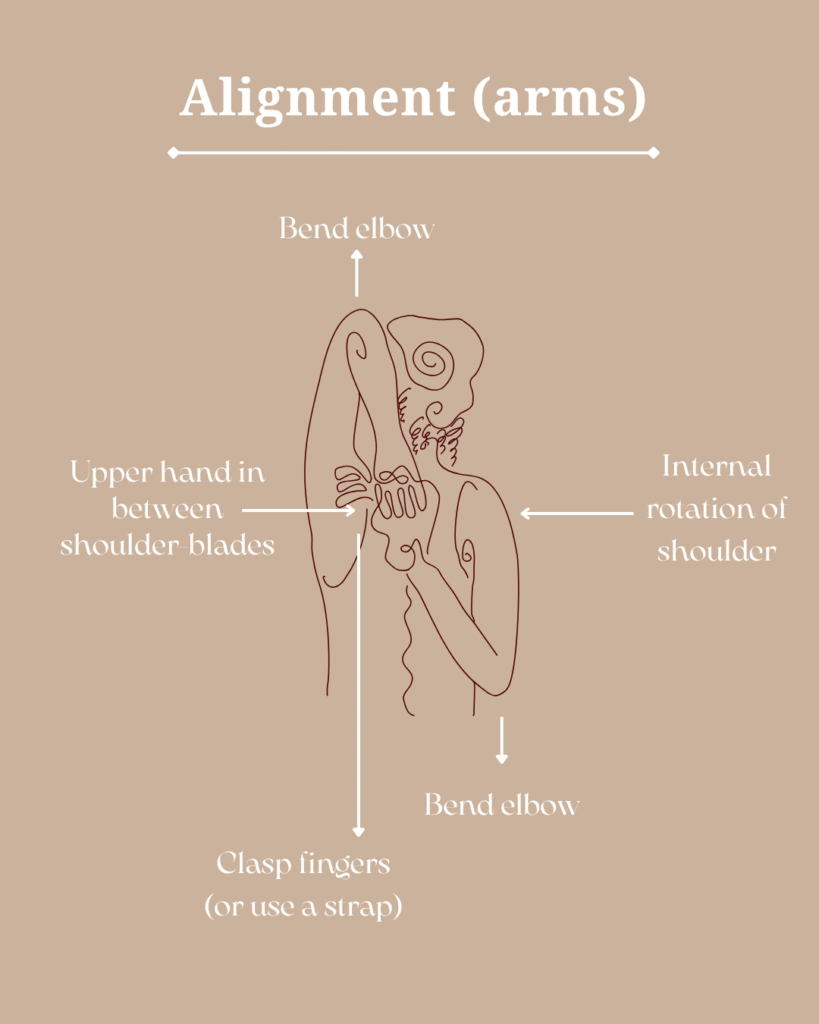
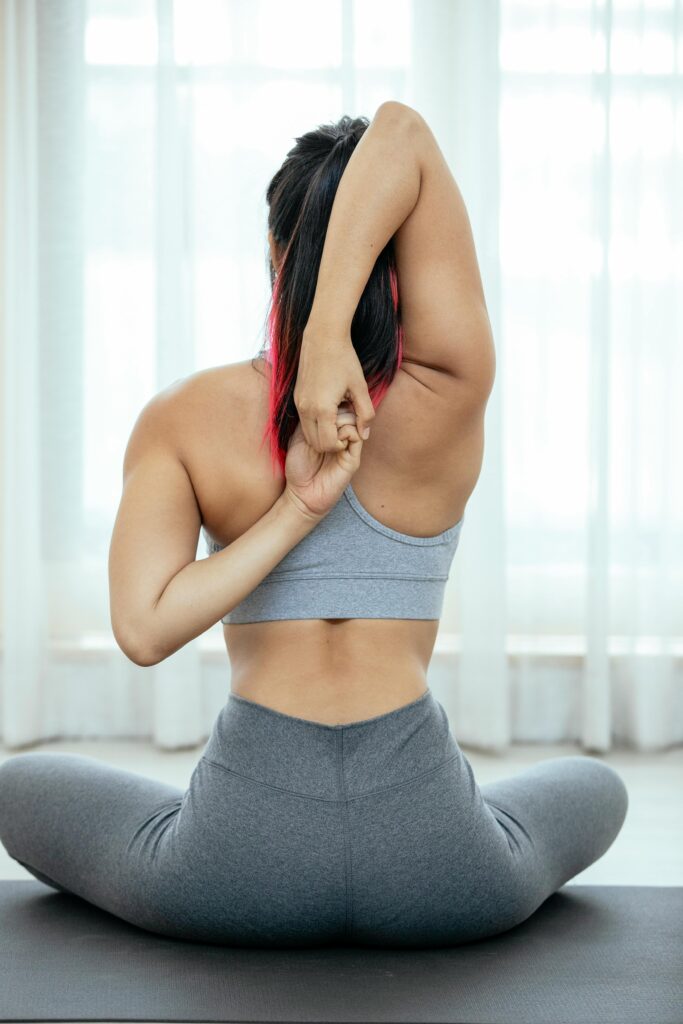
- Reach your right arm up toward the sky, then bend the elbow to bring the hand between your shoulder blades.
- Take your left arm out to the side, internally rotate it so the thumb points down, then bend the elbow and reach the hand up the back to clasp fingers (or use a strap).
- Draw the elbows in and lift the chest.
- The top elbow points up, and the bottom elbow points down.
- Keep your spine tall, chest open, and avoid collapsing forward.
- Stay for 5–10 deep breaths, feeling the stretch in the shoulders, triceps, and outer hips.
How to release
- Gently let go of your arms first.
- Then uncross your legs and shake them out before switching sides.
Repeat on the other side
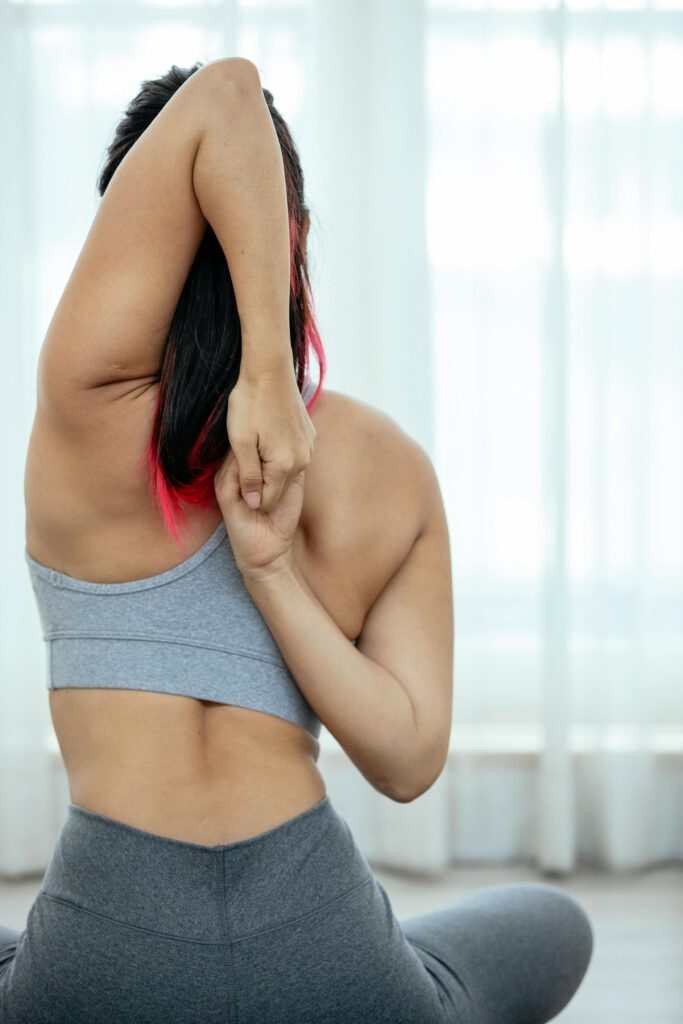
- Stack the knees with the left leg on top.
- Reach the left arm up, and the right arm down and behind.
Modifications
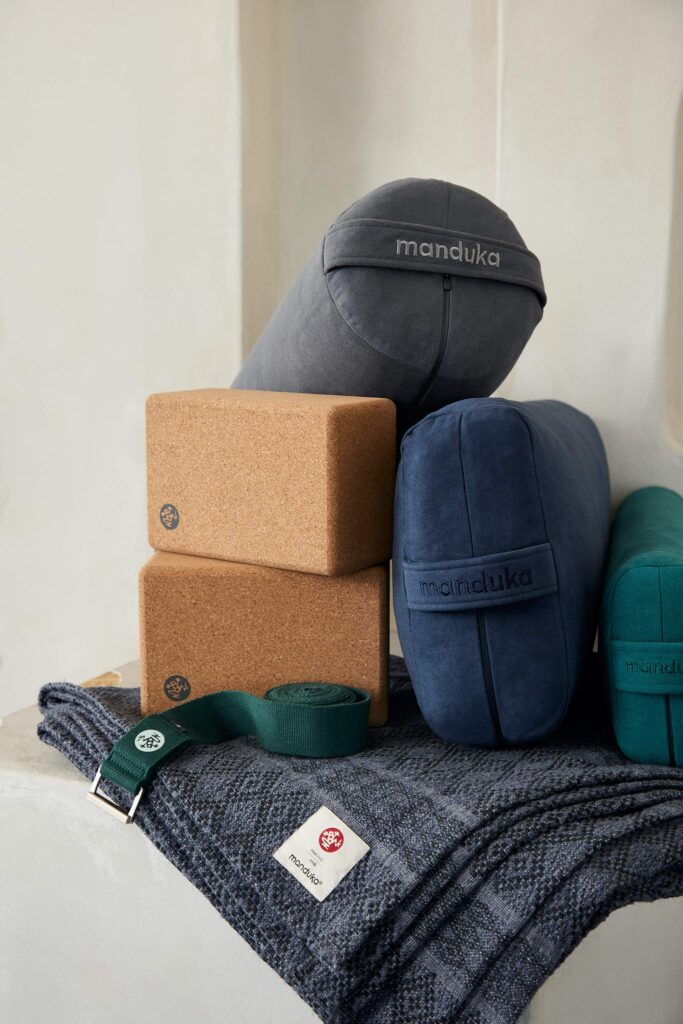
- Sit on a blanket or yoga blocks to elevate your hips.
This helps ease the stacking of the knees and relieves pressure on the hips and lower back—especially if your knees are high or your pelvis tucks under.
- Use a yoga strap or towel for the arms.
If your shoulders or elbows aren’t yet flexible enough to clasp behind your back, hold a strap or towel with both hands to bridge the gap and still enjoy the shoulder stretch.
- Practice one side at a time.
If the full pose feels overwhelming, try bending just one leg and one arm at a time. This gentler variation builds strength and mobility while maintaining the essence of the pose.
Who should not practice Gomukhasana?
Contraindications
- Avoid this pose if you have severe knee or hip injuries.
The deep external rotation and knee flexion can put strain on already compromised joints.
- Approach with caution if you have shoulder injuries.
Modify the arm position as needed—use a strap or skip the bind entirely to avoid aggravating the area.
- If you have high blood pressure, be mindful of holding your arms overhead for extended periods.
This may elevate pressure further, so keep the arm position brief or skip it altogether.
- Refrain from practicing if you’re recovering from recent knee, hip, or shoulder surgery.
Give your body ample time to heal before attempting deep postures like Gomukhasana.
- Pregnant women, especially in the third trimester, should avoid this pose.
The compression and positioning of the legs may limit circulation and create unnecessary discomfort. Also, it might compress the abdomen and is potentially unsafe for the mother and for the baby.
What’s the mythical history of Gomukhasana?
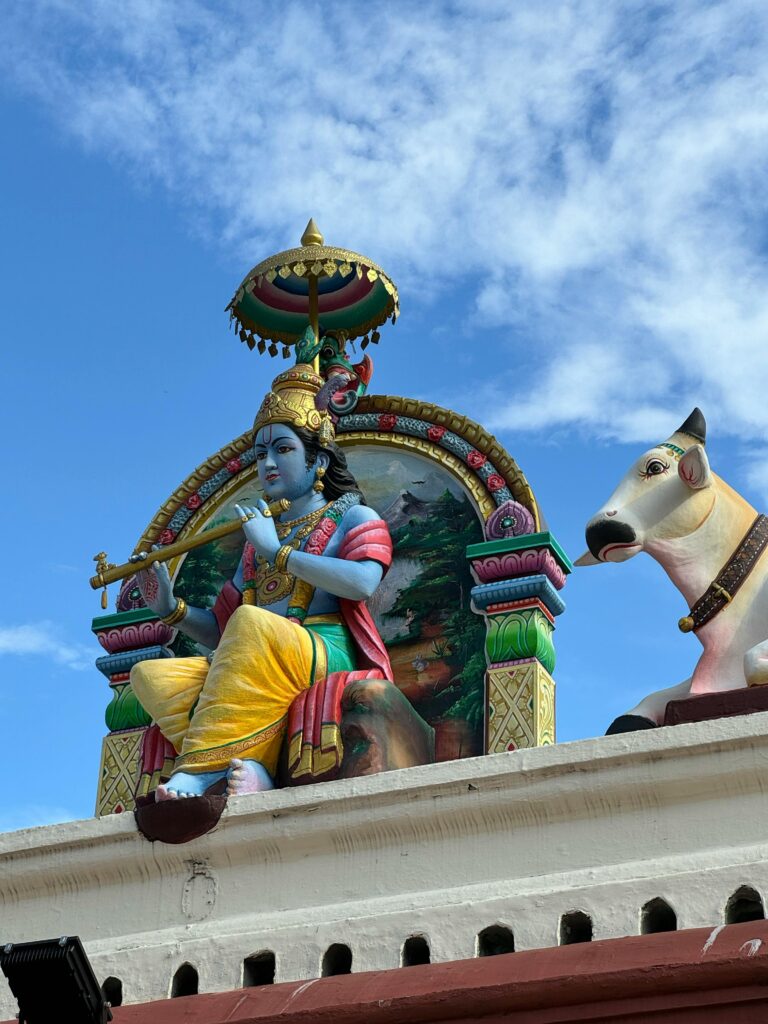
Krishna goes by many names, but two of the most charming are Gopala (“protector of the cows”) and Govinda (“caretaker of the cows”). Clearly, he had a thing for bovine royalty.
There’s a tale in which Brahma, the grand creator of the universe himself, starts getting a little skeptical. “Wait a minute,” he thinks, “This flute-playing, cow-herding boy? Divine? Really?” (For context: in Hinduism, Krishna is believed to be an avatar of Vishnu, the preserver of the universe—kind of a big deal.)
So, Brahma decides to test him…
One day, while Krishna was resting in the forest with his cowherd friends and their calves, Brahma swooped in and kidnapped all the boys and animals, hiding them in a cave. Mischievous move, right? Then, curious to see Krishna’s reaction, he quietly returned to spy on him.
To his astonishment, there was Krishna—still happily playing with the very same boys and calves Brahma had just stolen. Confused, Brahma rushed back to the cave. Yep, they were still there, exactly where he’d left them.
He looked back and forth—with all four of his heads (yes, four!)—from Krishna to the cave and back again. Somehow, impossibly, there were now two sets of boys and calves.
That’s when it hit him: Krishna had multiplied himself, becoming each and every cowherd boy and calf. Brahma, the creator himself, had been outwitted by the cowherd kid with the flute.
In yogic tradition, this story reminds us that the spirit of Krishna can take any form, especially the form of someone we love spending time with. Just like Krishna adored the cows and his friends, divinity can shine through anyone whose presence brings us joy.
The name Krishna means “all-attractive,” symbolizing the human ability to become exactly what another person needs in a given moment: a shoulder to cry on, a hand to hold, a reason to smile.
So when we sit in Gomukhasana (Cow Face Pose) we’re symbolically putting on another face. Just like Krishna, we step into a role with presence, love, and intention—offering our “all-attractive” selves for the benefit of those we care about.
🌿 Final Reflections on Gomukhasana
Gomukhasana might look like a pretzel-y puzzle at first, but there’s more to it than just stacked knees and stretchy arms. Behind the pose is a playful story about Krishna, cows, and the reminder that sometimes, we show up for others in unexpected but meaningful ways.
Whether you’re sitting in the pose or just doing your best to keep it together in daily life, Gomukhasana is a little nod to all the roles we play—the friend, the listener, the one who brings snacks or much-needed hugs.
So next time you’re in Cow Face Pose, remember: it’s not just a stretch—it’s a wink to your inner shapeshifter. The one who shows up, with love, however needed.
If Gomukhasana sparked something in you, stay tuned for the next entry in the Asana Encyclopedia, and subscribe to my newsletter.
The Science Behind Stillness: How Yin Yoga Rewires Your Body | Part 2
Following up on my latest yin yoga article, I’ll delve deeper into how Yin Yoga…

Asana Encyclopedia. Vrikshasana (Tree Pose): Meaning, Alignment & History.
Today, I’ll unpack what Vrikshasana (Tree Pose) means in Sanskrit and share the story and…

The magic of Stillness: Yin Yoga Rewires Your Body | Part 1
Ever wonder why you wake up feeling like a rusty robot, or why that forward…
Yoga Anatomy Series | Part 1: Understanding Body Language & Movement Planes
As a yoga teacher, I understand the struggle of completing your 200-hour YTT —and sometimes…
How to survive your first yoga class?
Following up on the subject of how to get ready for your first yoga class,…
Asana Encyclopedia. Tadasana (Mountain Pose): Meaning, Alignment & History.
I’m going to break down what Tadasana (Mountain Pose) means in Sanskrit and also tell…
Pingback: Tadasana (Mountain Pose): Meaning, Alignment & History