
Today, I’ll unpack what Vrikshasana (Tree Pose) means in Sanskrit and share the story and symbolism behind its name. Because I know the struggle of hunting for clear modifications and alignment cues online, I’ll also cover the essentials you need to teach or practice this pose with confidence.
This article is part of a series for yoga teachers and practitioners who find Sanskrit terminology hard to remember. You can check the latest post right here.
What does Vrikshasana mean?
The name comes from two Sanskrit roots:
Vriksha (tree)
Asana (Posture)

Tree Pose is a one-legged balance: one foot anchors, the other nestles into the inner thigh; the arms sweep overhead, palms together. Roots in the legs, trunk through the torso, branches through the fingertips.
Rooting down and reaching up, Vrikshasana reflects the quiet resilience of trees and invites us to cultivate their power and adaptability.
Symbolism of Vrikshasana
For millennia, yogis have turned to the forest. Trees nourished and protected them—fruit to eat, bark and leaves for medicine, a canopy against the weather—so groves became their homes. Over time, the forest came to embody a pristine simplicity that supports contemplation beyond material possessions.
Students gathered in the cool shade to learn from their teachers, and many traditions tell of awakening beneath a single tree—the Buddha under the Bodhi tree being the most famous.
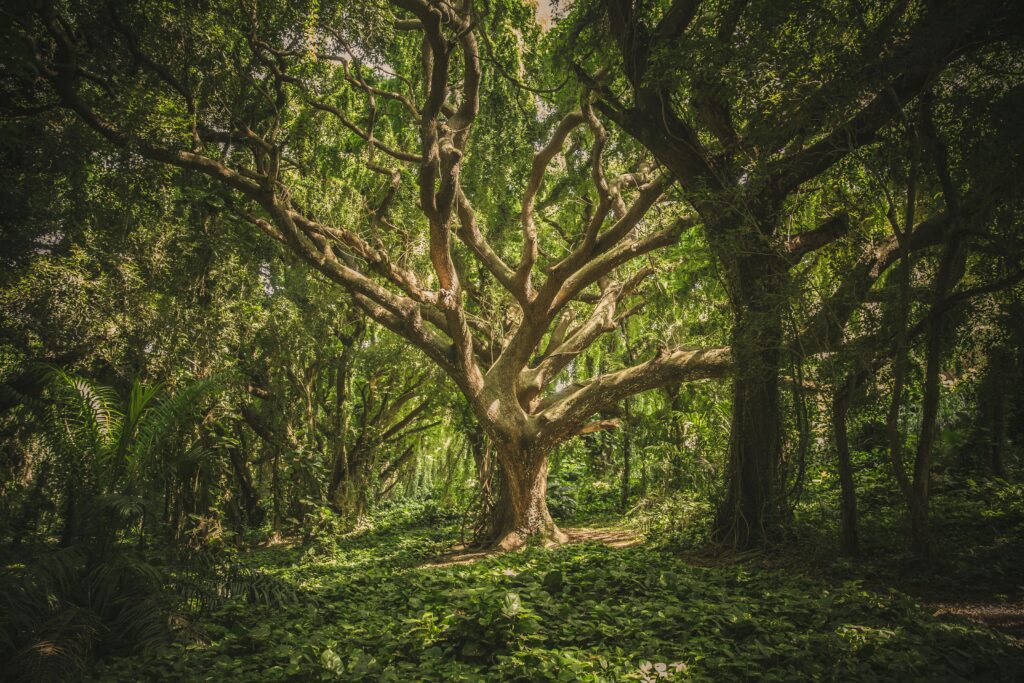
As Kaivalya and van der Kooij (2010) tell it, forest-dwelling yogis once recited a simple prayer:
My deer trees, creepers, insects and animals, please excuse me for taking a little piece of land to build my hut on. May we live together in harmony and peace.
This prayer speaks to the yogis’ vow to live gently with the land and reveals how the forest became their home. From humble huts to thriving ashram communities, the woods filled with practitioners.
Over time, these lived‑in forests were called Tapovan, the “forest of austerity”—a place for tapas and a pared‑back path toward awakening beyond material possessions.
This is the symbolism associated with this deeply grounding pose.
Alignment & Cues for Vrikshasana
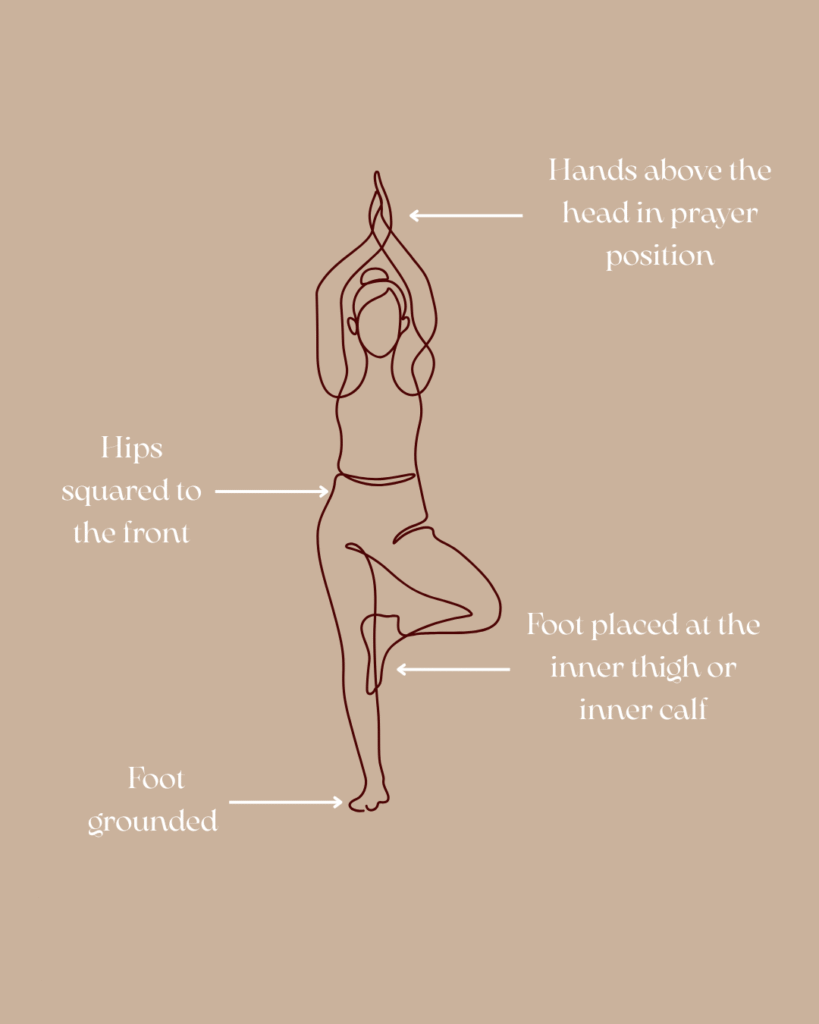
- Start in Tadasana (Mountain Pose). Press down through the four corners of both feet to feel grounded. Lengthen your spine toward the sky and soften your gaze on a single point (drishti) at eye level.
- Place your hands on your hips to help keep them level and square to the front. Shift your weight into your left foot—this is your anchor. Engage the left leg and lift the arch. Place your right foot to your left inner thigh or calf—never on the knee joint. Press foot and thigh into each other to stabilize.
- Keep your hips facing forward; notice if they start to rotate or tip. This is a hip opener, so let the external rotation come from the hip, not the knee. Prioritize sensation in the hip rather than forcing the knee outward.
- If you feel steady, bring your palms together at your heart or reach your arms overhead. Keep the ribs softly in, shoulders relaxed, and the crown of the head lifting. Stay for 5–10 breaths, rooting down through the standing leg as you rise tall through the spine.
- Picture yourself as a living tree—grounded yet expansive.
- To exit, release your arms, gently lower your right foot to the mat, and return to Tadasana.
- Pause to feel the effects before repeating on the other side.
Modifications
- If raising your arms above your head makes you loose balance or is uncomfortable, you can keep them in front of your heart in namaste or at your hips (as a reminder for keeping them square to the front).
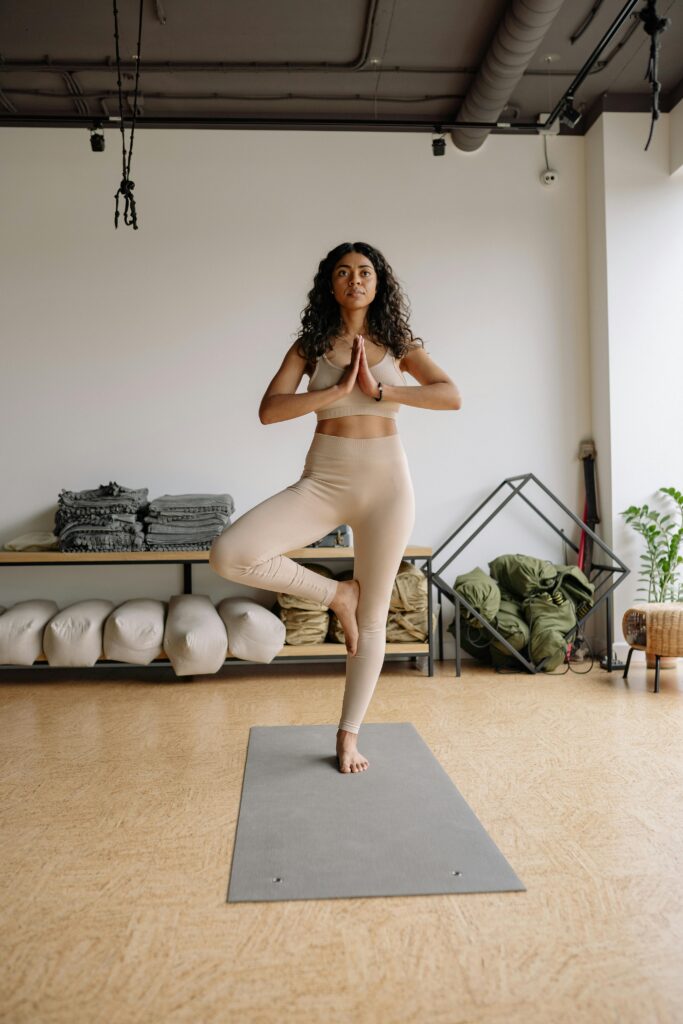
- If you’re struggling with balance, practice with your back against a wall or lightly hold a chair with one hand. You can also lie on your back and try the reclined version of Tree Pose—it’s great for relaxation.
- If you tend to hyperextend your knees, keep a soft micro-bend in the standing leg to protect the joint. Engage the quadriceps to lift the kneecap, co‑contract the hamstrings, and keep the knee tracking over the second toe. Root through the tripod of the foot (big toe mound, little toe mound, heel) and lift the inner arch. Think “soft but strong”—avoid locking out; grow tall through the crown.
Who should not practice Vrikshasana?
Contraindications & Precautions
- Do not practice the standing variation if you’ve had recent ankle or knee surgery. Choose the reclined version until cleared by your clinician.
- Pregnancy (2nd–3rd trimester): practice with a wall or chair for support and avoid long, unsupported holds.
- Recent hip replacement or known hip instability: avoid Tree Pose unless cleared by your surgeon. If cleared, keep the foot at the inner ankle and use wall support.
- Vertigo or vestibular issues: use a supported variation (wall or chair) or skip the pose to minimize fall risk.
What’s the mythical history of Vrikshasana?
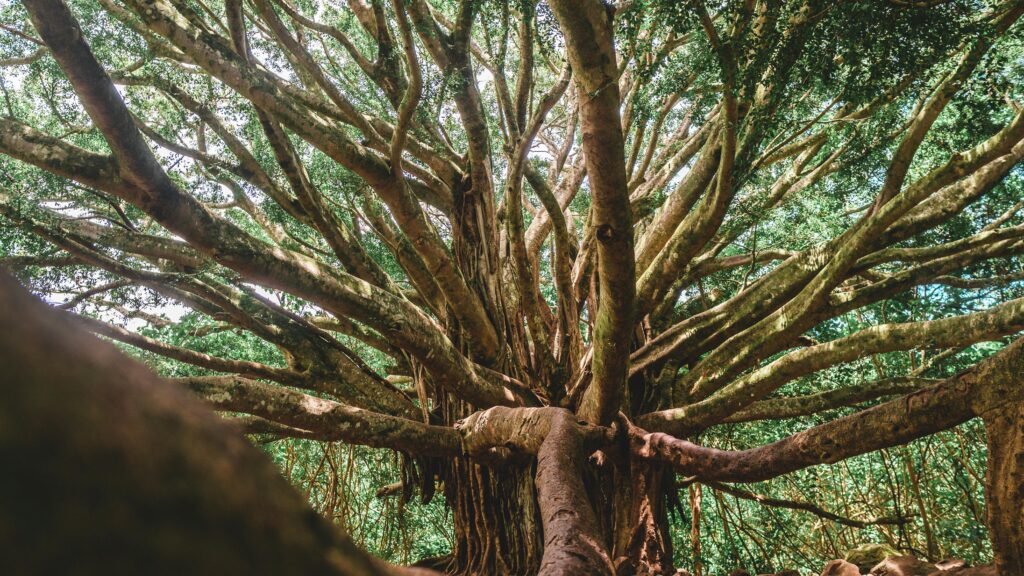
Unlike some poses, Tree Pose carries no singular myth. Instead, it points us to the forest itself as a symbol of the wider world—teeming, interdependent, and far larger than us. In the Bhagavad Gita, Krishna evokes the cosmic banyan whose roots reach upward and branches spread downward, a living image of creation and all species within it. Forests are the planet’s steady guardians: they breathe, store carbon, move water through the air, and hold the soil in place.
Final Reflections on Vrikshasana
In Vrikshasana, the body becomes a quiet grove: roots listening, trunk steady, branches open to light. Wobbles become teachers, breath becomes wind through leaves. May this shape remind us that we belong to a larger canopy of life—and that true strength is the softness that lets us sway without breaking.
If Vrikshasana sparked something in you, stay tuned for the next entry in the Asana Encyclopedia, and subscribe to my newsletter.
The Science Behind Stillness: How Yin Yoga Rewires Your Body | Part 2
Following up on my latest yin yoga article, I’ll delve deeper into how Yin Yoga…
Asana Encyclopedia. Vrikshasana (Tree Pose): Meaning, Alignment & History.
Today, I’ll unpack what Vrikshasana (Tree Pose) means in Sanskrit and share the story and…

The magic of Stillness: Yin Yoga Rewires Your Body | Part 1
Ever wonder why you wake up feeling like a rusty robot, or why that forward…
Yoga Anatomy Series | Part 1: Understanding Body Language & Movement Planes
As a yoga teacher, I understand the struggle of completing your 200-hour YTT —and sometimes…

How to survive your first yoga class?
Following up on the subject of how to get ready for your first yoga class,…
Asana Encyclopedia. Tadasana (Mountain Pose): Meaning, Alignment & History.
I’m going to break down what Tadasana (Mountain Pose) means in Sanskrit and also tell…